We were impressed with their ability to deliver consistently on time and within budget.
Clutch
View on Clutch


Let’s
Connect
Get the Best Price Today

Linked panoramas of every space, rendered from the drawings and published before the building exists. Opens in a browser, on a sales-center screen or in a headset. From $500.








A 360° virtual tour is a set of panoramas linked into a route: the visitor stands in the entry, turns around, clicks through to the living room, then the kitchen, then the terrace. Each panorama is a full sphere, floor to ceiling, so nothing is cropped away the way it is in a still image. The tour opens in any browser, runs full screen on a sales-center display and loads into a headset without being rebuilt.
Ours are rendered from the drawings, so the tour exists while the site is still a hole in the ground. Materials can be swapped, two finish packages compared side by side and a kitchen layout changed after the first week of feedback. We have built tours this way for developers since 2010, from the same models that produce the interior renderings of the units.
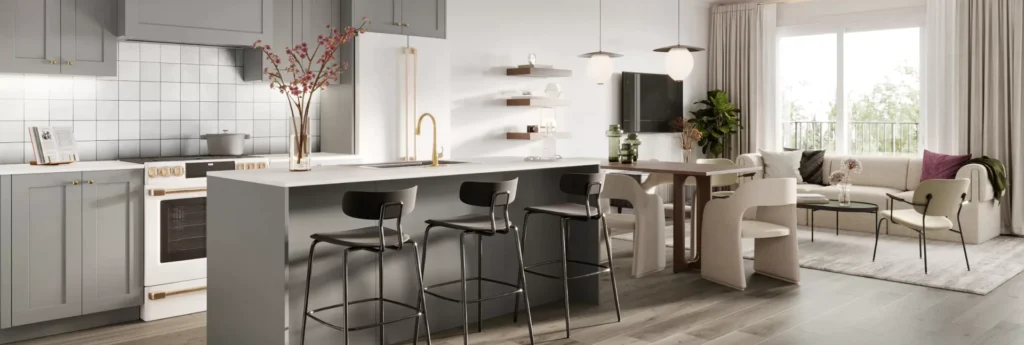
Developers selling off-plan. A tour of each unit type, published before the model unit is built, lets a buyer in another city or another country walk the layout on a phone. Viewings then happen with people who have already accepted the plan, and the conversation starts at price. A development with six layouts gets six tours that match in light, finish and styling, because they come from one model.
Commercial leasing. For an office floor or a retail unit, a tour answers what a plan cannot: how the daylight falls, what the view from the desk is, how far reception is from the elevator core. We build a fitted and an unfitted version of the same floor, so a prospective tenant sees both the shell and what it can become.
Hotels, amenities and hospitality. Lobbies, gyms, lounges, co-working floors and resident amenities sell on atmosphere, so these tours carry more lighting and styling work and usually fewer viewpoints. Three well-chosen positions do more than ten indifferent ones.
Buyers arrive pre-qualified. Someone who has spent four minutes inside the tour knows the ceiling height, where the windows are and how far the bathroom is from the bedroom. The viewings you get are with people who like the layout; the ones you avoid are with people who would have turned around in the hall.
One model covers the whole unit mix. Panoramas come from the same 3D scene, so the second and third unit types cost far less than the first, and all of them match. Photography of six model units never achieves that: they are built at different times, shot on different days and furnished by whoever was available.
It works on a phone, a monitor and a headset. The same tour opens in a mobile browser, runs on the sales-center screen and loads into a headset. You are not buying a format that only pays off with special hardware, and you are not tied to one platform: the panoramas are delivered in a form any viewer can read.
It exists before the building does. Because the tour is rendered, it can be published on launch day. Finishes can be changed, an upgrade package shown beside the standard one, and a unit type added when the phase is released, without rebuilding what exists.
Where a tour is the wrong tool. A tour rewards exploration, so it suits spaces people move through and decide about. For a single hero image on a site banner or a brochure cover, you want an exterior rendering. For a guided story with pacing and a beginning and an end, you want a 3D walkthrough. We will say which one fits before quoting the one with the bigger invoice.
The most common request: a tour of each unit type in a development, published before the model unit is built. Five to eight viewpoints per apartment, linked room to room, with a floor-plan navigator so the buyer always knows where they stand.
Fitted and unfitted versions of the same floor for leasing, with the view from the windows built from the real surroundings, so the tour answers the questions a tenant asks on a site visit.
Lobby, pool, gym, lounge and co-working floors, lit and styled for atmosphere, with fewer viewpoints and more care in each.
Panoramas from courtyards, roof terraces, podium gardens or a point above the development, linked so the visitor moves across the site. They pair with a site plan, which explains the layout while the tour shows what it is like to stand in it.
The same panoramas in a headset at the sales desk or an exhibition stand. This is the shortest route into virtual reality: no interaction to build, no real-time optimization, and the browser version keeps working for everyone who is not in the room.
1. Tour map. Every panorama is a fixed point, and the tour is the set of points plus the routes between them. You tell us which spaces matter and in what order a buyer should meet them. That map decides how many panoramas the project needs, and it is cheaper to settle now than after the spheres are rendered.
2. Model and cameras. We build the space and place the 360° cameras at standing eye height, about five feet three inches, because a sphere shot from the wrong height feels wrong even when the room is right. Each camera is checked for what sits directly above and below it: ceilings and floors are fully visible in a panorama.
3. Gray sphere test. Before any material goes on, every point is rendered in plain gray and opened in the viewer. Blind corners, doors that swing into the camera, awkward transitions and missing geometry show up here. Fixing them in gray costs hours; finding them after lighting costs days.
4. Color panoramas and linking. We light and finish the spheres, then link them: floor arrows, a plan in the corner, information points on materials and furniture. You review the result inside the viewer, moving through it as a visitor would.
5. Publishing. You receive the tour ready to embed on your site, or as a self-hosted package if marketing keeps everything in-house, plus the panorama sources at full resolution and still frames from any viewpoint for the brochure. Two rounds of corrections are included, and comments are collected per viewpoint so nothing is lost between the tour and the email about it.
| What | Price |
|---|---|
| Single 360° panorama | $500 – $1,200 |
| Virtual tour, starting price | from $500 |
| Typical tour | $500 – $3,000 |
The figures are the ones published in the rendering cost guide, and they hold for tours as well as single panoramas.
What drives the figure:
Send drawings or a model, the finish schedule and a list of the spaces you want covered. A fixed price, a production schedule and a written list of what is included come back within 24 hours.
 Next
3D Interior Rendering & Visualization Services
Next
3D Interior Rendering & Visualization Services
We were impressed with their ability to deliver consistently on time and within budget.
Their consistency in providing top-tier services is impressive in the workflow.
Freedes Studio has been fantastic to work with, especially Aelita. In a relatively short amount of time, I've already trusted them with several new construction projects, and the experience has been excellent. The turnaround time is consistently quick, the quality of the renderings is great and their attention to detail really stands out. Whenever I have comments or revisions, they are addressed quickly and thoughtfully, which makes the entire process very easy and efficient. As I continue to grow my company and brand as a home builder, Freedes Studio has been a great partner in helping me shape the visual identity of our homes and how I want our brand to be presented to the market. I truly appreciate Aelita and the entire Freedes Studio team for their continued help, responsiveness, and support. I look forward to working together on many more projects.
A set of panoramas linked into a route the visitor walks through in a browser or a headset, turning around in each space. Ours are rendered from drawings, so they exist before the building does.
A tour is explored: the visitor chooses where to stand and where to look. A walkthrough is a video with a fixed path, pacing and music. Tours suit spaces people decide about; walkthroughs suit a story told once.
Selling units off-plan, leasing office and retail floors, showing hotel rooms and amenities before opening, and sales-center screens and trade shows, where the same tour runs in a headset.
Five to eight per apartment, fewer for a single amenity space, more for an office floor with several zones. The tour map in the first step settles the number before anything is rendered.
Yes; most tours start that way. Plans, elevations and a finish schedule are enough. An existing 3D or BIM model shortens the job.
Yes. You receive an embeddable version and, if you prefer, a self-hosted package. The panorama sources come with it, so the tour can be extended later without rebuilding.
The number of viewpoints, the unit types and the interior detail decide it, and the delivery date is written into the quote. Adding a unit type to a finished model is a short job.
From $500, with typical tours between $500 and $3,000 and a single panorama between $500 and $1,200. The number of viewpoints, unit types, interior detail and interaction set the figure.
Freedes Studio: The Choice of Companies